
Carpenter Ants in My House: Why Are They Here?
Finding a large ant crawling across the kitchen counter, bathroom floor, or windowsill can raise an immediate question: Why is a carpenter ant in my house?
The answer isn't always that carpenter ants are nesting in your home. Carpenter ants found indoors may simply be workers from an outdoor colony looking for food. They can enter through gaps, cracks, utility openings, or routes that connect trees and vegetation to the house. Clemson Cooperative Extension notes that carpenter ants seen indoors are often coming from outside.
Carpenter ants can also establish nests or satellite nests inside structures, particularly where moisture or damaged wood provides favorable conditions. If you're seeing them repeatedly, finding them in the same part of the house, or noticing other evidence of activity, it's worth looking more closely.
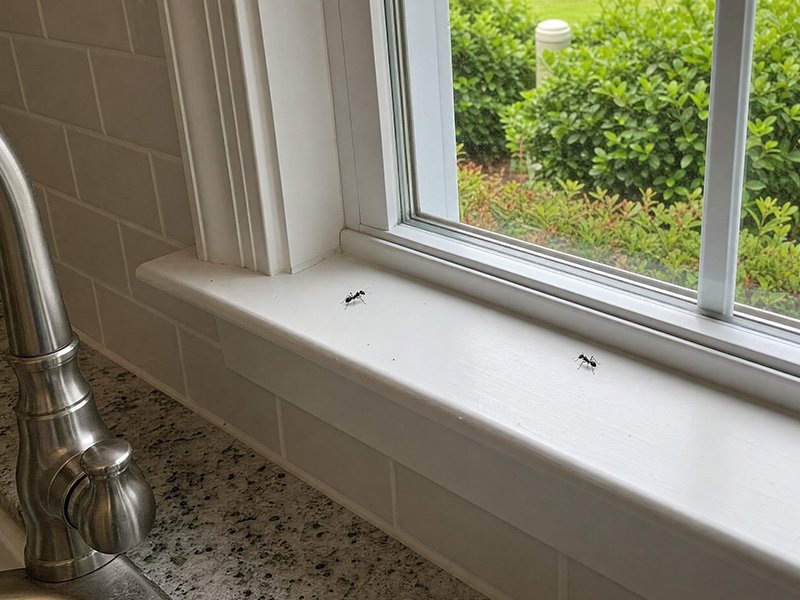
Why Am I Finding Carpenter Ants Indoors?
A carpenter ant inside your house is usually there for one of two broad reasons: it came indoors while foraging, or there is a nest somewhere in or around the structure.
Outdoor carpenter ant colonies often develop in trees, stumps, logs, and other protected areas around a property. Worker ants leave the colony to search for food and may enter nearby homes. Tree limbs touching the house, utility lines, and small exterior openings can provide entry points for them.
That means finding a carpenter ant in your kitchen doesn't necessarily mean its nest is somewhere behind the cabinets.
Repeated activity is different. If carpenter ants keep appearing in the same part of the home, there may be a nearby nesting site that deserves further investigation. Carpenter ants can establish satellite nests away from the main colony, including inside buildings, and moisture-damaged areas can be especially favorable because the wood is easier to excavate.
Does Seeing Carpenter Ants Mean They Are Nesting in My House?
Not necessarily.
A single carpenter ant, or even an occasional one, doesn't tell you where the colony is located. The ant could have traveled inside from a nest somewhere outdoors.
What matters more is how often you're seeing them and whether their activity appears concentrated in one area.
Situations that deserve a closer look include:
- Carpenter ants repeatedly appearing in the same room or area
- Large black ants emerging from a crack, wall void, window frame, or section of trim
- Coarse, sawdust-like material appearing below an opening in wood
- Winged carpenter ants emerging indoors
Winged ants are especially worth identifying correctly because carpenter ant swarmers are sometimes mistaken for termites. Our guide to ants that swarm in South Carolina explains what you may be seeing as winged ants begin to appear.
What Attracts Carpenter Ants to a House?
Moisture is one of the most important factors to consider.
Carpenter ants often take advantage of damp, decaying, or previously damaged wood. Around a home, areas affected by roof leaks, plumbing leaks, poor drainage, or other ongoing moisture problems can become more suitable for nesting.
Access matters too.
Branches and other vegetation touching the house can create a route onto the structure. Carpenter ants may also travel along utility lines or enter through cracks, gaps, and openings around pipes, cables, doors, and windows.
None of these conditions proves that carpenter ants are nesting inside the house. They simply make it easier for ants to get inside or find a protected location that suits their needs.
Where Can Carpenter Ants Nest Inside a Home?
When carpenter ants do establish a nest inside a house, it isn't always somewhere obvious.
They may use protected spaces in wall or ceiling voids, around windows, near plumbing, beneath tubs or showers, inside porch components, or in other hollow or concealed areas.
Moisture-prone areas are especially worth paying attention to when carpenter ant activity continues. A bathroom with a history of plumbing leaks, deteriorated wood around a window, or a damp area near a porch doesn't automatically mean carpenter ants are nesting there, but those conditions can provide useful clues when trying to determine where the ants are coming from.
This is also why the spot where you see the ant may not be the spot where the problem is located. Carpenter ants can travel away from a nest while searching for food.
What Are the Signs Carpenter Ants May Be Nesting in the House?
You don't need to assume the worst every time you see a carpenter ant. Instead, pay attention to evidence that suggests activity is concentrated in a particular part of the home.
One of the more recognizable signs is coarse wood shavings, sometimes called frass, that carpenter ants push out as they excavate nesting galleries.
Unlike termites, carpenter ants do not eat wood. They remove it to create space for the colony. The discarded material may contain wood fragments along with insect debris.
Repeatedly seeing ants enter or leave the same opening is another reason to investigate. So is finding winged carpenter ants emerging from inside the home rather than simply encountering a stray worker.
If you're unsure whether the ants you're seeing are actually carpenter ants, take a look at our pest guides to learn more about the types of ants in our region.
Do Carpenter Ants Damage Your House?
They can, but carpenter ants damage wood differently from termites.
Termites consume cellulose as food. Carpenter ants don't eat wood. Instead, they excavate galleries in wood to create nesting space, and a mature nest can occupy more than one nesting site.
For South Carolina homeowners, it's also important to keep the risk in perspective. Carpenter ants in the state do not typically cause extensive structural damage unless a colony becomes large and remains established for several years.
That doesn't mean ongoing carpenter ant activity should be ignored. It means seeing one ant shouldn't be treated as proof that your house has already suffered major structural damage.
The more immediate question is where the ants are coming from and whether there is an active nest in or around the home.
What Should I Do If I Find Carpenter Ants in My Home?
If you find carpenter ants indoors, the next step is to determine where they are coming from.
Because visible ants may be traveling from a colony elsewhere on the property, simply killing the workers you see may not address the source of the activity. A pest control professional can inspect the home, look for evidence of nesting, and help determine the appropriate next step.
If you've found carpenter ants in your home, contact Harris Pest Control for a home inspection.
Get Help for Your Carpenter Ant Problem
If you’re dealing with carpenter ants, our home pest control plans give you more than a one-time response. Our plans include coverage for carpenter ants and other common household pests, with year-round pest treatments and guaranteed protection to help keep covered pests out of your home.
Harris Pest Control has served the Pee Dee and Grand Strand since 1973. If you’re seeing carpenter ants in Florence, Myrtle Beach, or a nearby community, call (843) 595-9072 or request a free inspection today.
Additional Services














Get Started Today!